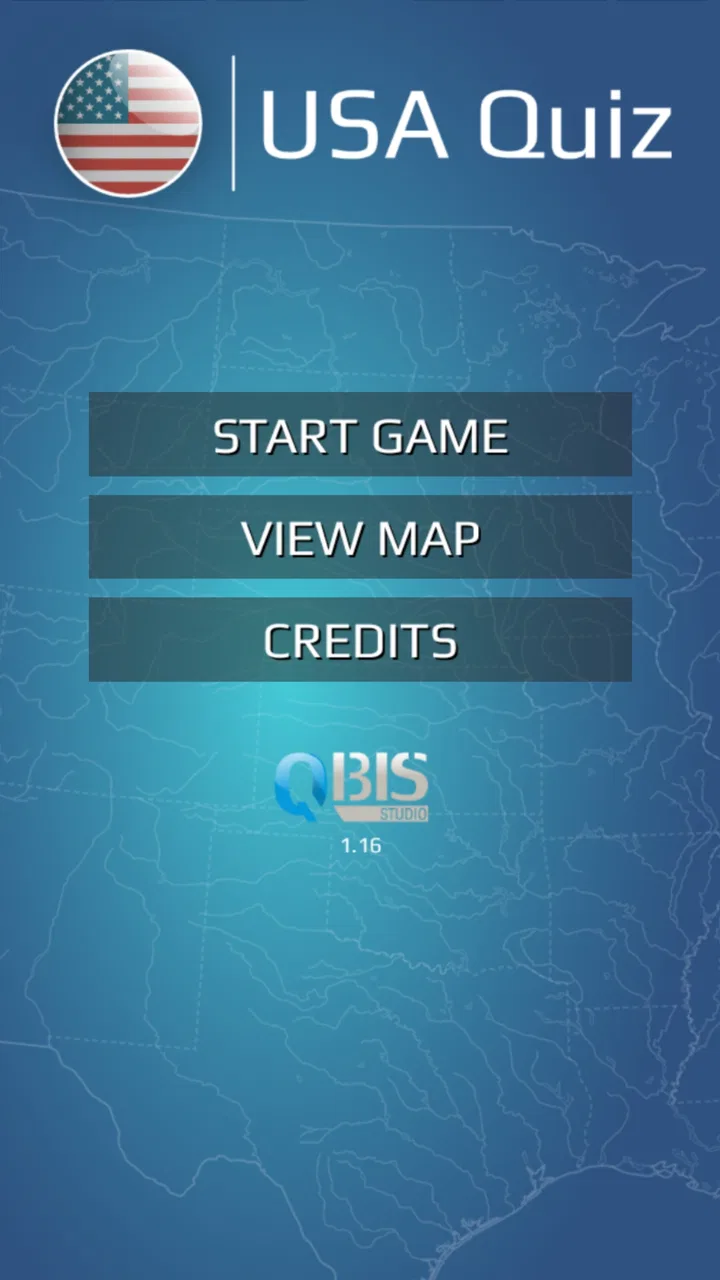
USA Quiz
- 4.8
- Rating
- 100.00K
- Installs
- Free
- Price

 Analysis by App-foxy
I found USA Quiz to be a friendly way to turn a vague knowledge of American geography into something more usable. It is a free trivia game from Qbis Studio, built around states, capitals, cities, and well-known places across the United States. The idea is simple, but the subject gives it more practical value than a typical collection of random quiz questions.
My first impression was that this is best approached as a short, repeatable learning game rather than a deep strategy title. You answer questions, notice where your memory fails, and gradually build a clearer mental map of the country. That makes it suitable for a relaxed evening, a quick study break, or a parent and child comparing answers together.
The game is rated for Everyone, so its subject matter is easy to share at home. It is also free to install, although optional in-app purchases range from $2.99 to $7.99 per item. The current version is 1.17.4 and it runs on Android 6.0 or later, which makes it accessible on many older devices as well as newer ones.
You May Also Like

 Blood Strike: 2.5 Anniversary
Blood Strike’s Loadouts Turn Every Drop Into a Tactical Gamble
A close look at Blood Strike’s custom loadouts: how fast access to signature weapons reshapes its battle royale rhythm, rewards preparation, and narrows the gap between fights.

 Pandora - Music & Podcasts
Pandora’s Music Is Easy to Start, but Harder to Recover
Pandora’s strength is its low-effort path from a seed to a station. Its weak spot is how much confidence it asks you to place in connection, setup, and quiet recovery.

 8 Ball Pool
 Is Built on Rivalries, Rematches, and Routine
A close look at the rivalries, rematches, shared routines, and unanswered safety questions that turn a quick pool match into a persistent mobile community.

 Samsung Music
’s Quiet Strength Is Playing What You Already Own
Its reach comes less from spectacle than from dependable access to a personal library. That simplicity is both the app’s strongest retention engine and its ceiling.

 AccuWeather: Weather Radar
AccuWeather Review: A Quick, Clear Forecast for Everyday Decisions
For everyday plans, the best forecast is the one you can understand quickly. AccuWeather makes rain timing, radar, and local conditions easy to act on, with a few trade-offs.

 Hill Climb Racing
Why Hill Climb Racing Still Turns Crashes Into One More Run
A tiny car, a bumpy hill and one more upgrade: Hill Climb Racing keeps resurfacing because its simple chaos makes every near-miss feel personal.
More From Our News Desk
View All News


What to expect when you start playing
USA Quiz does not try to overwhelm the player with a complicated interface or a long tutorial. Its appeal comes from the focused topic: learning the United States through questions about places and their identities. If you already know every capital, you may find the earliest questions comfortable, but the broader mix of cities and famous locations can still expose gaps in your knowledge.
I would describe the game as a bridge between casual entertainment and lightweight revision. It is not a replacement for a detailed atlas, a classroom lesson, or a serious geography reference. Instead, it gives you a reason to recall information actively. That distinction matters because answering a question from memory usually reveals more than simply reading a list of states and capitals.
The store summary points to three useful areas: states, capitals, and cities, with famous places included as another layer. In practice, that combination gives the game a natural progression in difficulty. State names can feel familiar, while capitals often require deliberate memorization. Cities and landmarks add context, helping you connect a name with a location rather than treating the country as a list of isolated facts.
One of the strongest reasons to try it is that each mistake can become a small study prompt. When I miss a capital, I do not need to stop and open a separate reference immediately. I can keep the question in mind, then use the next round to see whether the correction stayed with me. That makes short sessions more useful than mindlessly guessing through an endless quiz.
The game has attracted a 4.8 average from around 1.6 thousand ratings, and it has passed 100 thousand installs. Those figures suggest that the straightforward format has found an audience, but I would not choose it solely because of its store popularity. The real question is whether you enjoy learning through recall, repetition, and occasional wrong answers.
Who will get the most from it
USA Quiz is a good fit for someone beginning to learn American geography, especially a younger player who benefits from seeing knowledge presented as a game. It can also work for travelers planning a road trip, international learners who want a basic orientation to the country, and adults who remember state names but have forgotten many capitals.
I can also see it being useful in a family setting. One person can answer from general knowledge while another checks whether the capital or city is correct. Because the topic is narrow enough to understand quickly, there is less preparation than with a board game or a formal quiz night. A few rounds can become a simple way to fill a spare moment without needing a large time commitment.
On the other hand, experienced geography enthusiasts may want more depth than this format provides. If your goal is to study borders, physical geography, population patterns, or detailed regional history, a map application or a dedicated reference tool will be better. This game concentrates on recognition and recall, so it should be treated as an accessible learning companion rather than a complete geography course.
Getting through the first setup without friction
The first step is simply to install the game on a compatible Android device. Since the minimum operating system is Android 6.0, people using an older phone should check that requirement before expecting it to run. On a recent device, the setup should feel familiar to anyone who has installed a small trivia title: launch it, look through the opening screen, and begin with the available quiz flow rather than searching for advanced options.
I recommend starting when you have five or ten quiet minutes instead of opening it while distracted. The questions are short, but the learning benefit comes from thinking before tapping. If you rush because you are also messaging or watching something else, you may remember the speed of your guesses more than the information behind them.
A useful first-session routine is to keep a mental distinction between three kinds of answers. The first are facts you knew immediately. The second are answers you recognized after seeing the choices. The third are facts you genuinely did not know. That separation gives you a more honest picture of your progress than simply counting correct responses.
Because the game is free, you can test this routine without paying first. Optional purchases are available, with individual items priced between $2.99 and $7.99, but I would not make a purchase during the opening session. Spend enough time deciding whether the question style suits you. If the basic experience does not hold your attention, extra content or conveniences would not solve the underlying mismatch.
The age rating of Everyone also makes the setup comfortable for shared use. Still, I would sit with a younger player for the first round—not because the subject is difficult to access, but because a child may know a state name without understanding what a capital is. A quick explanation of the difference between a state, a city, and a capital can turn guessing into genuine learning.
Your first meaningful success
The first worthwhile goal is not to achieve a perfect round. It is to correctly answer a question that you previously missed. That small change shows that the game is doing more than measuring what you already know. After an incorrect answer, pause long enough to connect the place with a mental image, a region, or a travel memory. Even a simple association can make the next attempt easier.
For example, if a capital does not stick, say the state and capital together aloud once. Then avoid immediately repeating the same phrase over and over. Come back to it after several different questions. Delayed recall is more revealing, and it helps you notice whether the fact is becoming familiar or whether you only remember it because it was just displayed.
I found that the city and famous-place material can be used as anchors for the less familiar capital questions. A recognizable place gives you a story or image, while the capital is the precise fact you are trying to retain. Linking the two is more effective than memorizing a disconnected pair of names.
Another practical method is to divide sessions by purpose. Use one session to play naturally and discover weak areas. In the next, concentrate on remembering those weak areas rather than trying to cover everything. This prevents the common mistake of treating every question as equally important when a handful of recurring errors are actually holding back your progress.
If you are playing with someone else, take turns explaining why an answer seems right instead of only announcing the answer. A wrong explanation can be corrected immediately, and a correct explanation helps both players remember the reasoning. This works particularly well for children, who may recall a place more easily when it is connected to a short conversation.
Common confusion and the limits of the format
The most likely confusion is expecting the game to behave like a full interactive map. Its subject is American geography, but a trivia game and a map reference serve different purposes. A quiz asks you to retrieve information; a map lets you inspect relationships visually. If you need to understand which states border one another or where a city sits within a state, you may need another tool alongside this one.
It is also easy to mistake a high score for complete knowledge. A player can improve by remembering the patterns of a session without truly understanding the locations. I suggest occasionally answering slowly and asking yourself where the place is, what kind of place it is, and how it relates to the state or capital in the question. That extra mental step makes the game more educational.
Another limitation is that trivia naturally favors facts that have clear answers. Real geography is messier: cities can be culturally important without being capitals, famous places can be associated with a state even when their exact location is less obvious, and regional identity cannot always be reduced to one question. USA Quiz is strongest when you want a clean prompt-and-answer experience, not when you want a nuanced explanation of American places.
I would also avoid using it as the only preparation for a school test. It can reinforce recall, but a student may still need class notes, maps, and written practice. The game is especially useful after learning the material elsewhere because it tests whether the facts can be retrieved without looking at them. Used before any explanation, it may feel like a sequence of disconnected guesses.
Some players may wonder whether the free version is enough to judge the game. In my view, yes: the basic experience gives you a fair sense of whether this style of learning works for you. The in-app purchase range is worth keeping in mind if you are sensitive to paid extras, but there is no reason to spend immediately. First decide whether you enjoy returning to missed questions and building familiarity over several sessions.
People also often want to know whether it is appropriate for a child. The Everyone rating supports that use, and the topic is naturally educational. I would still treat it as a shared activity for younger children, since an adult can clarify vocabulary and prevent the game from becoming pure random tapping. Older children and adults can use the questions more independently.
How it compares with other ways to learn
Compared with a flashcard app, USA Quiz feels more playful and less like a scheduled study system. Flashcards are usually better when you want to control exactly which facts appear and track a structured review plan. This game is better when you want to start quickly, test yourself casually, and let the questions reveal what you have forgotten.
Compared with a broad trivia game, its narrow American geography focus is an advantage for targeted learning. General trivia can be entertaining, but it often jumps from history to science to entertainment without giving one subject enough repetition to stick. Here, the repeated focus on states, capitals, cities, and famous places creates a clearer learning path.
Compared with a map application, the trade-off is obvious. A map offers visual context and exploration, while this game encourages memory retrieval. I would use a map when I am trying to understand location and this quiz when I want to check whether I can remember what I have studied. The two approaches complement each other rather than compete directly.
Compared with a classroom worksheet, the game is less formal but easier to revisit. A worksheet may be better for writing names accurately or preparing for a specific exam. The app is more convenient for a quick round while traveling or waiting, provided the player treats wrong answers as learning opportunities instead of simply restarting.
Turning short rounds into lasting progress
My preferred next step after the first successful session is to create a small personal challenge: remember a few capitals, then test them again later without looking them up first. Do not try to master every state in one sitting. A smaller target makes it easier to notice real improvement and keeps the game from turning into a tiring memorization task.
You can also use the game before and after a trip. Before traveling, identify the states and cities connected to your route. Afterward, revisit the questions and attach the facts to places you have actually seen. Personal experience makes the information more memorable, and the quiz provides a light way to check whether those connections remain clear.
For educators or parents, a useful workflow is to let the game introduce a question, then extend it with a map or conversation. If the quiz asks about a capital, locate the state afterward. If it brings up a famous place, discuss what makes that place recognizable. This turns a short answer into a broader lesson without pretending the app itself supplies every explanation.
For independent learners, keep a simple note of recurring mistakes outside the game if that helps. Write the state and capital together, add a rough regional clue, and return to the quiz later. The important insight is that the app works best as the testing stage of a loop: learn, play, notice weaknesses, review, and play again.
The developer, Qbis Studio, has kept the concept focused rather than burying it under unrelated subjects. That focus is the reason I would recommend it to a beginner who wants a gentle entry into American geography. It is also the reason I would not recommend it to someone looking for advanced cartography, detailed explanations, or a highly customizable study platform.
After using it, my opinion is positive but specific. USA Quiz is not valuable because it makes geography complicated; it is useful because it makes a manageable group of facts easy to revisit. The free entry point, Everyone rating, and low device requirement make it approachable, while the optional purchases mean you can decide later whether the experience deserves extra spending.
My recommendation is to try it as a ten-minute learning habit, not as a one-time test. If you enjoy seeing a wrong answer become a correct one after a few rounds, this trivia game can steadily improve your knowledge of American states, capitals, cities, and famous places. If you need maps, detailed context, or formal exam preparation, pair it with a stronger reference tool—or choose that alternative instead.
FAQs for USA Quiz
01What is USA Quiz, and how does it work?
USA Quiz is an educational app designed to test your knowledge about the United States. It features various quizzes covering topics like history, geography, politics, and culture. Users can select different difficulty levels and compete with friends or other players online. The app offers a fun and interactive way to learn more about the USA.
02Is USA Quiz suitable for all age groups?
Yes, USA Quiz is designed to be family-friendly and suitable for all age groups. The app offers quizzes with varying difficulty levels, making it accessible to children, teenagers, and adults. Parents can use it as a learning tool for their kids, while adults can enjoy it as a casual educational game.
03Does USA Quiz require an internet connection to play?
USA Quiz can be played both online and offline. While an internet connection enhances the experience by allowing users to compete in live challenges and access the latest quiz updates, the app also features an offline mode. This ensures that users can enjoy the quizzes on the go without needing a constant internet connection.
04Are there in-app purchases or ads in USA Quiz?
USA Quiz is free to download and play, but it does contain in-app purchases and advertisements. Users can opt to purchase additional quiz packs or remove ads for an enhanced experience. The ads are generally non-intrusive, but purchasing the ad-free version can provide a smoother gaming experience.
05How frequently is USA Quiz updated with new content?
The developers of USA Quiz regularly update the app with new quizzes and features to keep the content fresh and engaging. Updates often include seasonal events, new topics, and improved gameplay mechanics based on user feedback. This ensures that users always have something new to explore and learn.
Pros
- Engaging trivia questions.
- User-friendly interface.
- Offline mode available.
- Regular content updates.
- Educational and fun.
Cons
- Occasional ads interrupt.
- Limited question categories.
- Some questions repeat.
- Requires internet for updates.
- Limited customization options.

USA Quiz
Gallery